Search!

Showing posts with label innovation. Show all posts

Aug 26, 2011

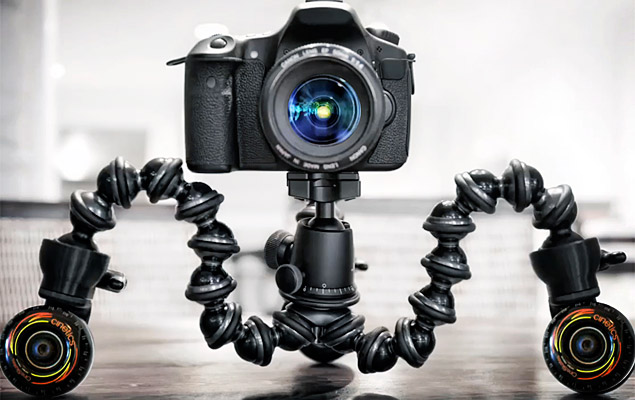
FUND THIS: Cineskates Make Your Camerawork Smooth As Silk


I love Kickstarter.  It's one of those sites that, the first time you hear about it, you immediately think, "Ohhhh, THIS is what the internet was built for."  Are you someone who's got some disposable income and some time to kill?  Spend a few hours (and a few dollars) on Kickstarter and make the dreams of some smart young innovator (or an entire city) a reality.  Chances are they'll throw you a finished product in appreciation.  Cineskates is one such product:


Having engaged in more than my fair share of cinematography over the years, I can attest that attempting to fake a smooth dolly move always produces a disappointing result, as evidenced by the pool table footage sampled above.  GorillaPods are one of the handiest, most versatile tools available for a budding young filmmaker and attaching skate wheels seems like such a natural progression that I'm amazed we haven't seen it before.  What I love most is the simplicity and versatility of design here, and clearly there are plenty of people out there who agree, as they blew their fundraising goal out of the water within a day.

Anyone got $150?  I want one.

Aug 23, 2011

Intel Writes Their Own Sci-Fi Future

Science fiction has always set the bar when it comes to technological innovation.  Futuristic books and movies have provided countless examples of inspiration for DIY inventors and technology corporations alike, not to mention us simple dreamers sitting in a darkened theater, awaiting the day when we'll have transporters and hoverboards of our very own.

It seems Intel got sick of waiting for Hollywood to tell them what to build next.  They've sponsored The Tomorrow Project, which aims to look at the future through the lens of new and emerging technology.  The project is already yielding results, specifically an anthology of technology-centric short stories from acclaimed sci-fi writers Douglas Rushkoff, Ray Hammond, Scarlet Thomas and Markus Heitz.  The entire collection is currently available as a free download right here, along with a few interviews, podcasts, etc.

I haven't read through them yet, but I give Intel credit for at least creating an interesting platform for discussion, as well as new creative works.  I can't wait to see what other voices and influences they're able to bring on board over time, along with any new content they're able to generate.

Props to my buddy Ryan (@ArchitectureMNP) for the heads up.

Aug 17, 2011

Get Ready For Floating Countries

Peter Thiel has a lot of money.  A LOT of money.  The guy founded PayPal, but he's probably better known as the billionaire angel investor who brought Facebook into the big time.  That makes him largely responsible for a major share of both the social and commercial interactions of the virtual world.  Now Thiel wants to move into the physical world.

According to Details Magazine, Thiel's Founders Fund (co-founded with Napster creator Sean Parker) has just donated $1.5 million to the Seasteading Institute, a group that plans to build a series of independent floating/underwater libertarian city-states located in international waters.  Seasteading is the brainchild of Patri Friedman, grandson of Nobel Prize-winning economist Milton Friedman.  He's hoping to utilize Thiel's recent donations to build a prototype series of floating offices just off the San Francisco coast within the next year.  He projects that they could have fully populated compounds within seven years, and aims to have millions of residents in his floating libertarian utopia by 2050.

One conceptual model even has companies like Apple literally purchasing and forming their own sovereign nations, complete with "no welfare, looser building codes, no minimum wage, and few restrictions on weapons."  While I'm sure plenty of Apple aficionados would enthusiastically sign on to live on an island devoid of Windows, I'd think that actual governments would be none to happy to let companies literally export workers to their own countries with no minimum wage laws.  Fortunately it'll be quite some time before floating corporate nations are a legitimate concern.  It's too bad, as this sounds like Ron Paul's best chance to get elected leader of anything.


Turn Your Bike Into A Tron-esque Light Cycle

I recently joined a bike sharing program that just launched here in Boston.  It's kinda great.  There are bike hubs spread throughout the city, making it easy for me to grab a bike and drop it off pretty close to wherever I happen to be going.  (Fortunately for me, there are hubs literally right outside both my apartment and my office, making my daily commute a far more enjoyable experience.)  I've even taken a few late-night rides, as each bike is equipped with flashing lights to warn passing motorists of your presence on the road.

However, some dinky reflectors don't hold a candle to these Revolights.  Kent Frankovich has brought the concept of automobile headlights and taillights to the bicycle by adding a series of bright LEDs to both the front and rear tires.  When the tires spin, the lights shine forward and backward, not only making you more visible on the road, but also lighting the path in front of you.  Plus, it looks awesome.


revolights. join the revolution. from revolights on Vimeo.


Get more info here at Revolights or donate to to the project's Kickstarter page here.  If I were an actual bike owner instead of just a renter, I would add these to my wheels without hesitation.

Aug 11, 2011

INNOVATION LAB: Instant Bricks, Robot Skin & (Missing) Gliders

Thought I'd give a quick rundown of some really interesting inventions and innovations that have hit the wire this week.

First up we've got CO2 Structure, a new creation out of Japan designed to help rebuild areas affected by natural disasters like earthquakes.  TIS Partners out of Japan discovered that by blowing CO2 into loose silica, the material instantly hardens into whatever shape is chosen, like say, a brick.  By adding an organic material like epoxy or urethane, you get a substance that's up to 2.5 times stronger than concrete, requires next to no steel reinforcement and takes about 60 seconds to create.  That's compared to up to 28 days for concrete to set into its maximum potential strength.  In areas like Japan and California that are not only struck by frequent earthquakes, but also strong aftershocks, CO2 Structure could be a serious game changer when it comes to reconstruction.


Next we've got GelSight, a layer of rubber with a painted skin that will conform to a surface and reveal microscopic details.  Originally developed to give robots a more accurate sense of touch, GelSight can be combined with a lit camera to create incredibly detailed 3D models.  Obviously the material has the potential for some incredible and varied applications, notably in fields like forensics and ballistics.


Finally, there's today's test launch of DARPA's Falcon Hypersonic Glider, which is designed to be launched into the upper atmosphere then glide down at speeds of up to Mach 20 and launch conventional weapons at any target on the planet within an hour.  This is the second test flight for the unmanned Falcon: the first test was last April and it did not go well at all.  In fact, the Air Force lost contact with the glider after a mere 9 minutes.  Today's test went much better.  This time they got a full 36 minutes into the flight before they lost telemetry and the Falcon went off the grid.  (Lest you think there's a stray DARPA glider out there waiting to be found, rest assured that the craft has a built in self-destruct mechanism.)  The Falcon is an incredibly cool looking ship.  Maybe next time they'll actually be able to land the damn thing.

Aug 10, 2011

NASA Ponies Up For Innovation

This week, NASA launched a program designed to help support risky future technologies, some of which may never pay off.  NASA Innovative Advanced Concepts (NIAC) awarded 30 contracts worth $100,000 each to various groups who've proposed some very out-of-the-box ideas like an air gun for clearing orbital debris, 3D-printable miniature spacecraft, and concepts for lunar colonies and advanced spacesuits.

Despite NASA's chronic lack of funding, the NIAC program is meant specifically for concepts and innovation which most would consider too risky to invest in, yet could potentially provide a huge payoff and bring about major breakthroughs in a number of fields.  While I'm sure some will declare the program to be wasteful spending, I absolutely love this idea.  If NASA was a sports franchise we'd call this a rebuilding year, so I love that NASA is branching out a bit, re-branding themselves as a haven for innovators and a proving ground for future technology.  Invention often comes from the most unlikely of places, and sometimes discovery is born in the pursuit of completely different goals.

I can't wait to see what they come up with next.

Aug 1, 2011

And He Finished His Pepsi And Said "Let There Be Light!"

Now THIS is innovation.

The fine folks at MIT put on their thinking caps and came up with this brilliantly simple way of bringing indoor lighting to villages with no electricity.  By filling a one liter plastic bottle with water and pacing it in a hole specially cut into the roof of a house, the sunlight refracts through the water and gives off the equivalent light of a 60W incandescent bulb.  Add a little bleach to keep bacteria from forming and clouding up the water and you've got a light source that will last you up to five years.

Sadly Reuters is stingy with their embedding, so click it here to see the "Liter Of Light" in action.

Here's my favorite part of this story: anyone could have come up with this solution.  Seriously, if given a little time and focus, a fourth grader could've figured this out.  The world needs more of this type of innovation; simple solutions to serious problems.  On that note, I was recently able to witness a day of really excellent TED talks and I'll be putting up videos from some of my favorites in the coming days and weeks.  Stay tuned.